
When investors review their performance report, the first thing they usually focus on is: RETURNS.
Most investors see both numbers TWRR & XIRR but do not know which one to trust for what purpose. Mutual funds often highlight CAGR.
So, which one actually matters?
The reality is:
“TWRR vs XIRR vs CAGR is not a debate about which metric is better. It is about understanding
what each one measures and when to apply it.”
What is TWRR?
TWRR, or Time-Weighted Rate of Return, measures investment performance by removing the impact of investor cash flows like additional investments or withdrawals. This makes TWRR the right metric for evaluating fund manager skill. A large investment made just before a market fall would hurt a money-weighted metric.
What seems like a discount can quickly become a value trap.
Methodology:
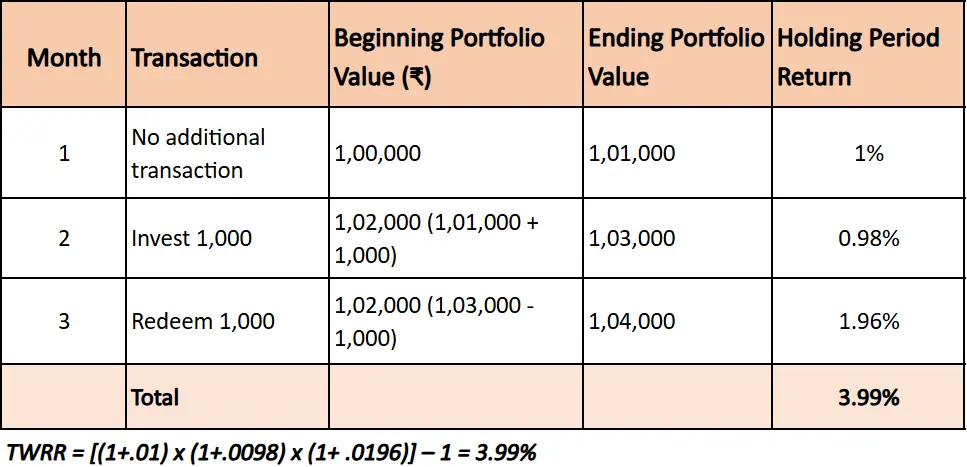
The total investment period is broken down into smaller sub-periods, with a new sub-period starting everytime there is a cash inflow or outflow. The return for each individual sub-period is calculated, and these returns are then geometrically linked (multiplied together) to determine the return for the entire period.
Example of TWRR Calculation:
What is XIRR?
XIRR, or Extended Internal Rate of Return, measures the actual annualized return earned by an investor after considering the timing and amount of all cash flows.
XIRR is sensitive to timing. Investing a large amount just before a market fall will produce a lower XIRR even if the fund manager performed well.
Methodology:
Example of XIRR Calculation:
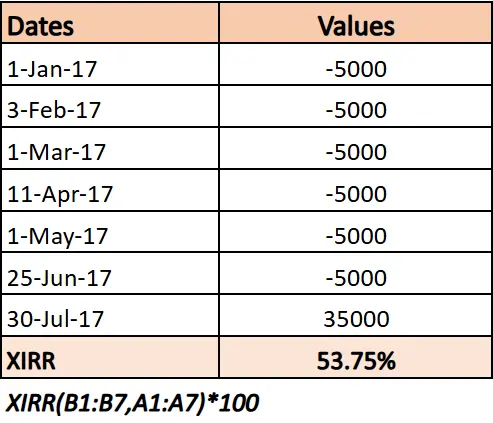
Note: For XIRR calculation purposes, all investment cash outflows are represented with a negative (-) sign, which is why the periodic investments are shown as -5000. The current portfolio value is represented with a positive (+) sign, which is why the ending value of 35000 is shown as positive.
What is CAGR?
CAGR (Compound Annual Growth Rate) represents the constant annualized rate of return that would be required for an investment to grow from its initial balance to its final balance, assuming all profits were reinvested. It completely ignores volatility and any interim cash flows, providing a “smoothed” average growth rate over a specific number of years.
Methodology:
It requires only three inputs: the beginning value, the ending value, and the total time in years. It is best
used for lump-sum investments with no additional deposits or withdrawals.
CAGR = ((Ending investment value)/(Starting investment value) )^(1/(Investment horizon))-1
Example of CAGR Calculation:
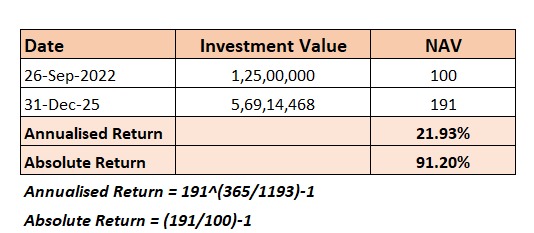
- Annualized return shows the average yearly compounded growth rate of the investment.
- Absolute return shows the total gain or loss on an investment over the entire holding period.
REGULATORY & REPORTING
How PMS Providers in India Use TWRR
SEBI mandates that all registered PMS providers report client performance using TWRR. This regulation exists specifically to prevent managers from benefiting or suffering due to investor-driven cash flow timing. The standardization makes it possible to compare two PMS products on a level basis.
PRACTICAL GUIDANCE
Which Metric Should You Use and When?
Use TWRR when..
- Comparing two PMS strategies/provider or fund
managers - Evaluating whether a strategy
beat its benchmark - Reading your SEBI-standard PMS performance report
- Removing the effect of your own cash flow timing
Use XIRR When..
- Tracking your actual personal investment return
- Calculating returns on an SIP or recurring investment
- Comparing your return to a fixed deposit rate
- Understanding what your capital actually earned
Key Takeaways
- CAGR is for ads. XIRR is for investors. TWRR is for fund managers.
- XIRR is personal – it reflects your actual return based on when you put money in or took it out.
- TWRR strips out cash flow timing to reveal how a fund truly performed – independent of you.
- SEBI mandates TWRR for all the PMS Performance reporting in India, making it a standard for fair comparision.
Why This Matters for PMS Investors?
As one of the top boutique PMS services in India. Turtle Wealth Management works with HNI families, business owners, and wealth creators across the region. One of the most common questions we hear during portfolio review sessions is: “Why is the return in my report different from what I expected?”. The answer, almost always, comes down to which metric is being used and for what purpose.
Whether you are exploring quant investment strategies, looking for a family office partner, or simply want a clear portfolio review, understanding XIRR, TWRR, and CAGR is the first step.
Regards,
Kirti Golicha – Research Analyst