
“Today: The edge is no longer having a quant approach to investing. It is having a better quant approach.”
01 – The Shift
Three years ago, saying “we run a quant strategy” was enough to stand out. Today it barely qualifies as a differentiator because everyone is running one.
Nearly half of all new PMS strategies launched in 2025 were quant or factor-based a sharp jump from just a few years ago, when the approach barely existed here.
02 – Two Investors, One Morning
9:15 AM. The market is falling. Two investors are staring at the same red screen.
Watching. Waiting. Wondering.
He owns a stock he believes in, but it's falling fast. Buy more? Wait? Sell? He isn't panicking, but he's worried checking the news again, waiting a little longer.
"While he's still deciding, the moment often slips away."
Nothing to decide today.
He already decided weeks ago. When to buy, when to hold, when to sell were written down before the market got shaky.
"No hesitation, no guessing he just follows the plan."
This is where a better quant approach makes a real edge.
03 – Where AI Fits In and Where It Doesn’t
A quiet shift is happening inside quant investing itself: the datasets feeding the models have grown far richer. For decades, systematic strategies leaned almost entirely on structured numbers earnings, balance sheets, price movements. Today, AI and machine learning make it possible to process unstructured information too: management commentary, patent filings, news flow, and other alternative data at a scale and speed that simply wasn’t feasible even a few years ago.
But it’s worth being precise about what AI actually does here, because there’s a common misconception worth correcting:
” AI does not pick stocks.
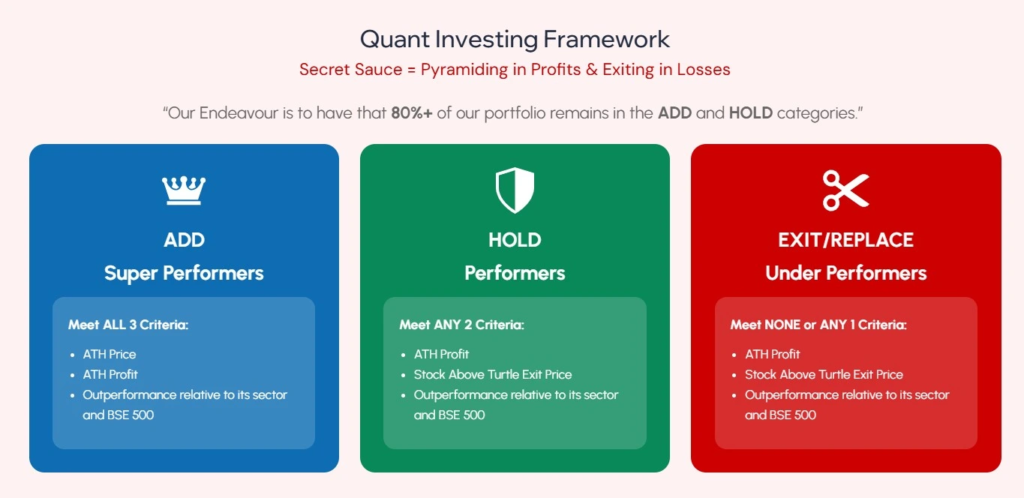
What AI does is widen the lens and speed up the analysis. It helps process more information, faster but the rules themselves, the logic behind why a stock qualifies for ADD, HOLD, or EXIT, are still built, tested, and owned by a human research process.
A model output nobody can fully explain.
Every decision traceable to a specific data input and an economic rationale.
04 – The Turtle Quant Framework
The Turtle Quant Process runs on the same pre-decided system for every stock. It doesn’t wait for a sector/stock to become fashionable before it looks there it’s sector-agnostic by design, so whichever sector is running at any given time, its qualifying stocks surface in the process automatically. A stock earns its place in the ADD file on its numbers not on the story being told about it that week.
We didn’t build our quant process to chase a trend. We built it to remove the one thing that costs investors the most : hesitating at the wrong moment.
05 – What Comes Next
Evolution, Not Revolution
Conclusion
PMS offers direct ownership and a personalized portfolio, so the responsibility of accurate reporting and timely payments rests with the investor. Understanding the tax implications of investing in PMS in India is essential for investors to make informed decisions aligned with their financial goals and tax planning strategies. The tax treatment of gains, dividends, asset types, and holding periods significantly influences the overall tax liabilities associated with PMS investments.
“Your real return is what you keep after tax. Plan for it from day one.”
Frequently Asked Questions About PMS in India
Regards,
Kirti Golicha – Research Analyst
DISCLAIMERS:
Turtle Wealth Management Pvt. Ltd. (hereinafter referred to as “the Company”) is a SEBI registered Portfolio Manager, SEBI Reg. No: INP000006758. Investments in the securities market are subject to market risks, and there is no assurance or guarantee that the objectives of any investment portfolio will be achieved. Past performance is not indicative of future results. Above performance data is not verified by SEBI.