
Thinking of investing in PMS? The first feeling is usually excitement. The second is anxiety about fees.
How much will I pay? What if markets fall? Will I pay even when I don’t make money?
Fair questions. PMS needs a minimum of ₹50 lakh, so before you invest, you should know exactly how the fee works.
Understanding PMS Fee Structures:
1) Fixed Management Fee:
The management fee is the base fee charged on your portfolio value. Think of it as the operational cost of running your strategic portfolio. It is usually calculated as a percentage of your Assets Under Management (AUM), commonly ranging between 1% to 3% per year.
Example:
If you invest ₹1 crore in a PMS strategy and the management fee is 2%, the annual fee would be ₹2 lakhs. This is charged irrespective of market performance (Even in flat and negative year).
Who may prefer a fixed fee?
A fixed fee may appeal to investors who:
Want predictable costs
Prefer a simple fee arrangement
Don't want to share a portion of exceptional returns
Are comfortable paying a management fee regardless of market performance
2) Performance Fee:
This fee model is like win-together model. The manager earns a performance fee only if the portfolio beats a minimum return – the hurdle (often 8–12%, or a benchmark).
Example:
You invest ₹1 crore. At the end of the year, your portfolio grows to ₹1.50 crore. You’ve made a profit of ₹50 lakhs.
If the performance fee is 15%, then:
₹50 lakhs × 15% = ₹7.5 lakhs performance fee.
You retain ₹42.5 lakhs in profit.
But what happens if the next year markets fall?
This is where the high-water mark becomes critical.
Who may prefer a fixed fee?
It may suit investors who:
You believe strongly in performance-based compensation
You expect strong returns above the 8% hurdle rate
You want to minimize fixed costs in down market years
You value maximum alignment between your returns and fee payments
Understanding PMS Fee Structures:
The high-water mark (HWM) protects investors from paying performance fees repeatedly for the same gains.
The high-water mark is the highest value your portfolio has ever reached. You pay a performance fee only on gains above that old high – so if it dips and climbs back, you don’t pay twice for the same money.
Peak.
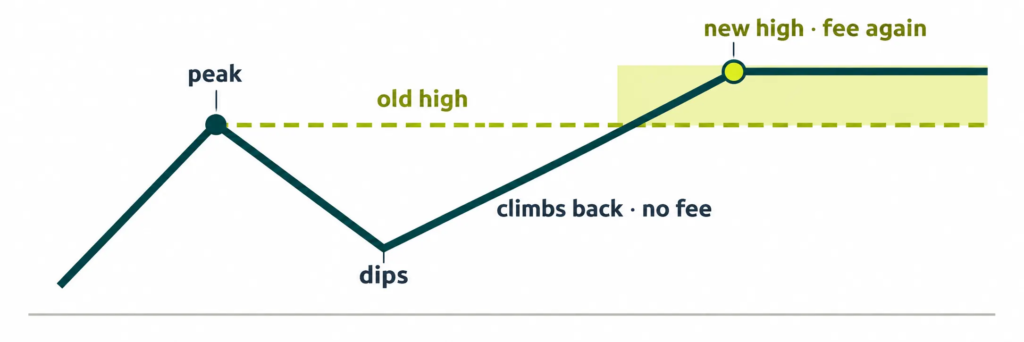
Year 1: You invest ₹1 crore. The portfolio grows to ₹1.40 crore. Performance fee is charged on ₹40 lakhs. The new high-water mark becomes ₹1.40 crore.
Year 2: Markets decline. Portfolio falls to ₹1.10 crore. No performance fee is charged.
Year 3: Portfolio recovers to ₹1.35 crore. Still no performance fee, because it hasn’t crossed ₹1.40 crore.
Year 4: Portfolio rises to ₹1.50 crore. Now performance fee is charged only on the new gain above the previous high-water mark, that is ₹10 lakhs (₹1.50 crore minus ₹1.40 crore).
Without a high-water mark, you could end up paying performance fees even during recovery phases. With it, you only pay for genuine new wealth creation. This mechanism significantly reduces fee anxiety and builds long-term trust between investor and manager.
3) Hybrid Fee:
Hybrid fee plans offer a blend of fixed and performance-based compensation for portfolio managers. This structure caters to investors who value both predictability and the potential for additional returns based on performance.
Example of Hybrid Fee:
You invest ₹3 crore in a PMS with a hybrid fee structure of a 1% fixed fee and a 15% performance fee above a 12% benchmark. Here, you would pay a fixed fee of ₹30 lakh (₹3 crore * 1%) every year irrespective of the performance. Additionally, if your portfolio grows to ₹3.6 crore (a 20% return) after a year, your profit would be ₹60 lakh (₹3.6 crore – ₹3 crore). The performance fee would then be ₹9 lakh (₹60 lakh * 15%). This structure offers a combination of predictability and potential for additional performance-based fees.
Who may prefer a hybrid structure?
It may suit investors who:
Want a balance between fixed and performance-based fees
Prefer some cost predictability
Want the manager to participate in the upside
Don't want to rely entirely on either fee model
4) Other Charges:
Beyond management and performance fees, PMS providers pass through certain charges at actuals:
Demat, brokerage, GST, STT (Securities Transaction Tax), exchange charges, stamp duty, and other statutory levies
Bank and custody charges
Certification or professional charges, and Registrar & Transfer Agent fees
GST on all of the above, plus applicable taxes
Any other direct cost the manager incurs while managing your money
Understanding Turtle Wealth PMS Fee Structure:
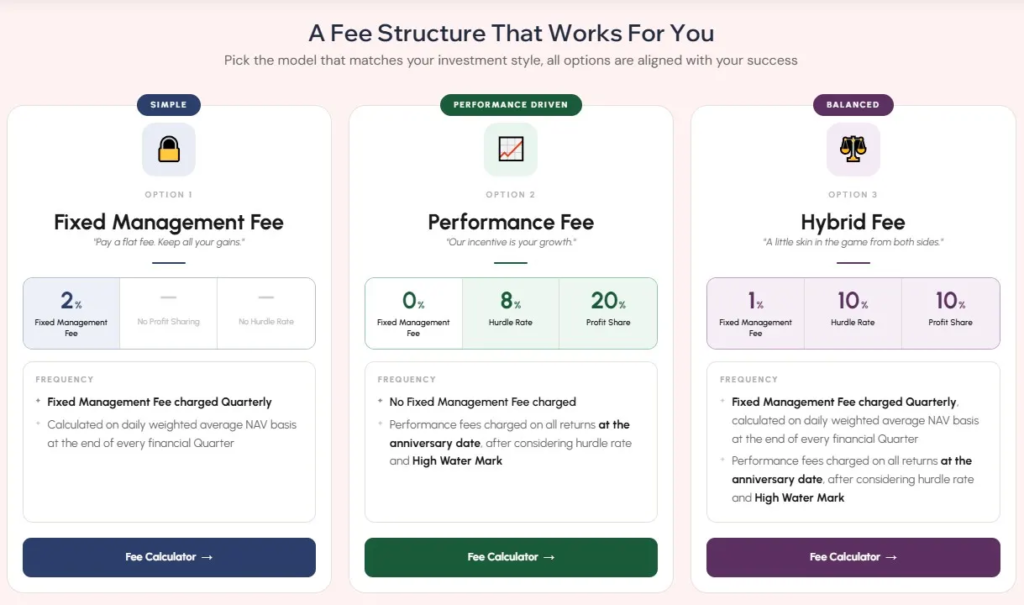
At Turtle Wealth, we believe in transparency and flexibility when it comes to investment management fees. Our Portfolio Management Services (PMS) offerings come with three distinct pricing models designed to cater to different investor preferences and investment objectives. Whether you prefer a fixed management fee approach, are comfortable with performance-based compensation, or seek a balanced hybrid model, we have a structure tailored for you.
Entry/Exit Load Fee
This refers to the fees associated with the buying and selling of shares within the PMS.
- Entry Load (0%): This is the fee charged when you invest money into the PMS. In our case, there’s no entry load, meaning you won’t be charged any fee when you start your investment.
- Exit Load (0%): This is the fee charged when you withdraw money from the PMS. Again, our PMS doesn’t charge an exit load, ensuring you can withdraw your funds without any additional charges.
Conclusion
Understanding PMS fee structures isn’t just about knowing what you’ll pay – it’s about knowing what you’re paying for. A fee structure with a high-water mark, transparent hybrid options, and no entry/exit loads tells you a lot about how a manager thinks about aligning with your interests. Always ensure you’re clear on all charges and consult with financial experts before making any investment decisions.
Regards,
Kirti Golicha – Research Analyst
DISCLAIMERS:
Turtle Wealth Management Pvt. Ltd. (hereinafter referred to as “the Company”) is a SEBI registered Portfolio Manager, SEBI Reg. No: INP000006758. Investments in the securities market are subject to market risks, and there is no assurance or guarantee that the objectives of any investment portfolio will be achieved. Past performance is not indicative of future results. Above performance data is not verified by SEBI.